

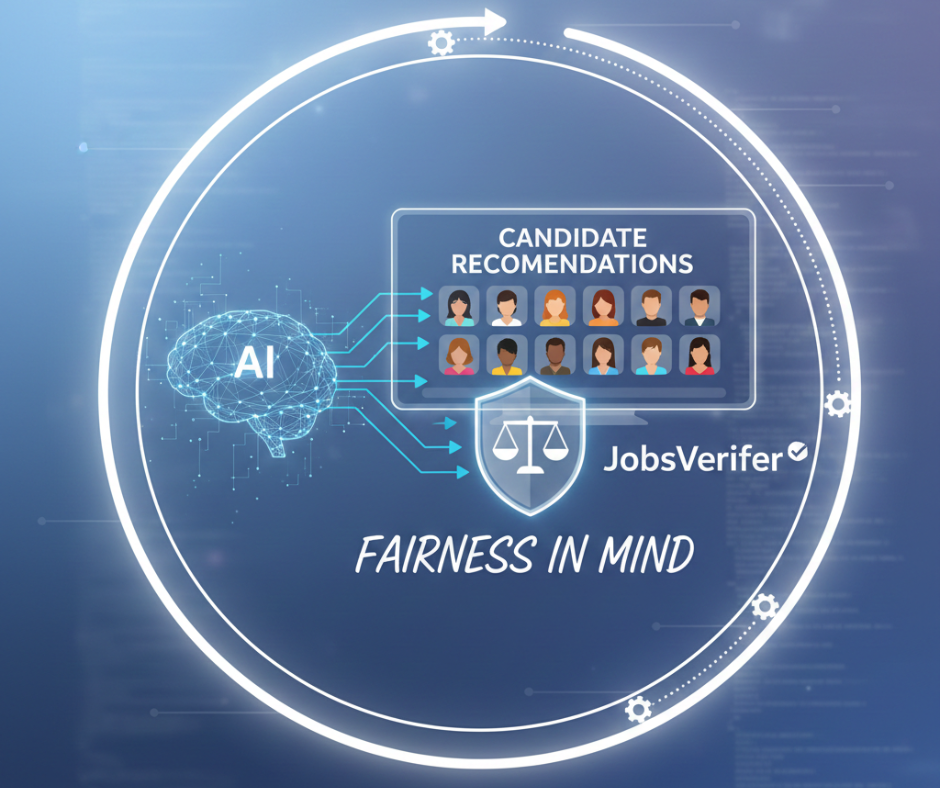
AI ethics in candidate recommendations: how JobsVerifier keeps fairness in mind
Artificial intelligence is reshaping how people find jobs. From resume screening to candidate recommendations, AI helps match the right talent with the right opportunities faster than ever before. But with this power comes responsibility.
Candidates today don’t just ask “Will this platform help me get hired?”
They also ask “Is it fair?”
At JobsVerifier, AI is designed not just for efficiency — but for ethical, transparent, and bias-aware hiring. This blog explains why AI ethics matter in recruitment and how JobsVerifier keeps fairness at the center of candidate recommendations.
Why AI Ethics Matter in Hiring
AI systems learn from data. If that data reflects bias, outdated practices, or incomplete information, the results can unfairly disadvantage qualified candidates.
Common ethical risks in AI-driven hiring include:
- Favoring certain backgrounds or companies
- Penalizing non-linear career paths
- Overweighting keywords instead of skills
- Reinforcing historical hiring biases
- Lacking transparency in recommendations
Without ethical safeguards, AI can unintentionally amplify inequality instead of reducing it.

What Ethical AI Means at JobsVerifier
Ethical AI is not about removing automation — it’s about using it responsibly.
At JobsVerifier, ethical candidate recommendations are built on four key principles:
- Fairness
- Transparency
- Verification
- Human Oversight
These principles guide how recommendations are generated and presented to candidates.
1. Skills First, Not Background Bias
Traditional hiring systems often favor:
- Specific universities
- Famous company names
- Linear career paths
JobsVerifier’s AI prioritizes:
- Skills relevance
- Role compatibility
- Verified job requirements
- Experience quality over brand names
This helps candidates from diverse backgrounds — including career switchers, remote workers, and self-taught professionals — get fair visibility.
2. Reducing Algorithmic Bias Through Data Design
Bias doesn’t just come from algorithms — it comes from data.
JobsVerifier actively works to:
- Avoid single-source data dependency
- Balance employer and candidate inputs
- Monitor skewed recommendation patterns
- Continuously refine matching signals
By diversifying and validating inputs, the system avoids repeating the same hiring shortcuts that exclude capable candidates.
3. Verified Jobs Reduce Ethical Risk
Unverified or misleading job posts distort AI recommendations.
JobsVerifier reduces this risk by:
- Recommending only verified listings
- Checking employer authenticity
- Validating salary and role claims
- Flagging suspicious or inconsistent posts
Ethical AI starts with ethical data, and verification is a core part of that process.

4. Transparent Recommendations for Candidates
Candidates should never wonder “Why was I shown this job?”
JobsVerifier emphasizes clarity by:
- Showing why a role matches your profile
- Highlighting key skills and requirements
- Allowing filters and controls
- Avoiding hidden ranking logic
Transparency builds trust — and trust is essential when AI influences career decisions.
5. No Black-Box Hiring Decisions
JobsVerifier does not let AI:
- Reject candidates automatically
- Make final hiring decisions
- Hide opportunities without explanation
AI assists discovery — humans make decisions.
This ensures candidates remain in control of their job search and are never silently filtered out without reason.
6. Supporting Inclusive Hiring Outcomes
Ethical AI also means supporting inclusion.
JobsVerifier’s systems are designed to:
- Surface diverse job types (remote, hybrid, flexible)
- Recognize transferable skills
- Support skills-based hiring
- Avoid penalizing career gaps or freelancing
This reflects the realities of modern work — not outdated hiring models.
7. Continuous Monitoring and Improvement
AI ethics isn’t a one-time setup.
JobsVerifier continuously:
- Audits recommendation patterns
- Reviews candidate feedback
- Adjusts weighting signals
- Improves fairness metrics
Ethical systems evolve — and so does JobsVerifier’s approach.
Why Ethical AI Benefits Everyone
For Candidates
- Fair access to opportunities
- Transparent job discovery
- Reduced bias and confusion
- Confidence in recommendations
For Employers
- More relevant applicants
- Better skill alignment
- Stronger employer trust
- Reduced reputational risk
Ethical AI leads to better hiring outcomes for both sides.
The Future of Fair Hiring
As AI becomes more embedded in recruitment, ethical responsibility will separate trustworthy platforms from risky ones.
The future belongs to hiring systems that:
- Respect candidates
- Support diversity
- Verify employers
- Combine automation with accountability
JobsVerifier is built with this future in mind.
Final Thoughts
AI should open doors — not quietly close them.
At JobsVerifier, candidate recommendations are designed to be fair, transparent, and accountable, ensuring that technology supports human potential rather than replacing it.
In modern hiring, ethical AI isn’t optional — it’s essential.