

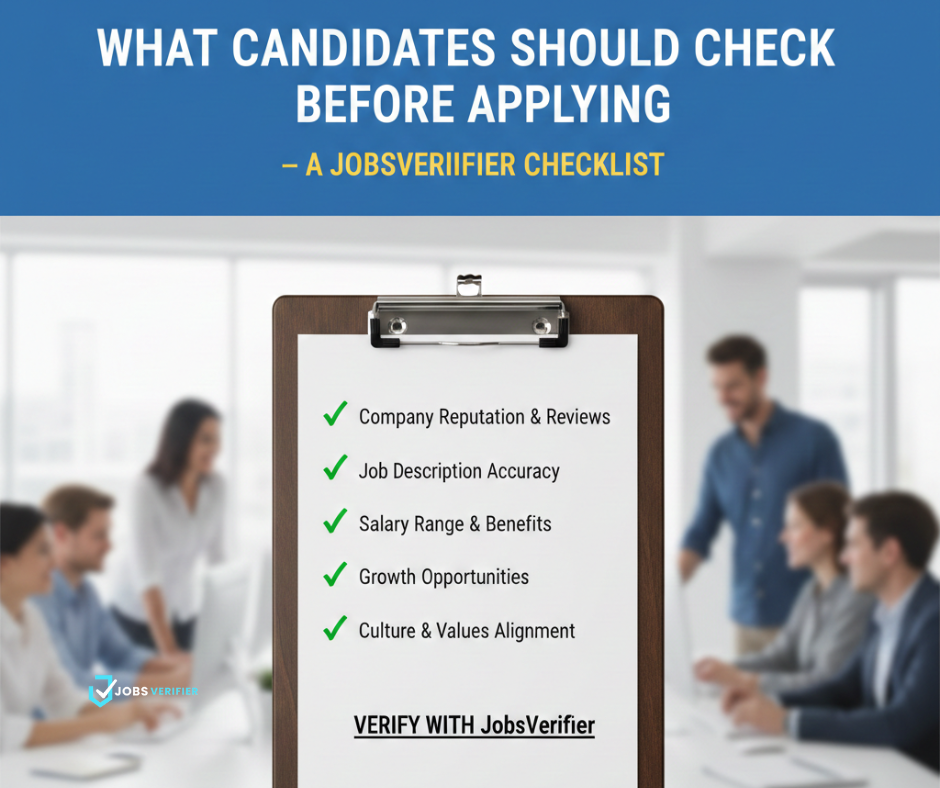
What candidates should check before applying — a JobsVerifier checklist
Searching for a job in 2025 feels like navigating a maze — full of amazing opportunities, but also full of fake recruiters, scam job posts, and ghost companies. With job fraud increasing every year, candidates must be more alert than ever. And that’s exactly why JobsVerifier has created a smart, simple, and powerful checklist to help job seekers confirm whether a job is real — before clicking “Apply.”
This checklist is designed to protect candidates from scams, misinformation, toxic employers, and fake job listings. If you use it each time you apply, you’ll dramatically improve your job search safety and success.
Let’s dive into the ultimate JobsVerifier Candidate Checklist.
✅ 1. Verify the Employer’s Digital Identity
Before applying, make sure the employer is real and active.
What to check:
- Do they have an official website?
- Is the website professionally built — not a cheap template?
- Does the contact email match the company domain (not Gmail/Hotmail)?
- Is the domain old enough (not created last week)?
🚩 Red flag:
If the website looks poorly built, has broken pages, or no company details — it may be a fake employer.
✅ 2. Check the Company’s Social Media Presence
Real companies have genuine activity on platforms like:
- Twitter/X
- TikTok (if relevant)
What to look for:
✔ Real followers
✔ Real comments
✔ Regular posting
✔ Employee-tagged posts
🚩 Red flag:
Accounts with:
- Zero posts
- Fake followers
- Stock images
- Sudden new accounts
These often belong to scam recruiters.
✅ 3. Review the Job Description Carefully
Many fake postings reuse the same template or exaggerate offers. A real job post is clear, structured, and specific.
A real job post should have:
- Clear responsibilities
- Realistic requirements
- Salary (optional, but ideal)
- Company info
- Location details
- Contact person or HR name
🚩 Red flag:
- Unrealistic salaries
- “No experience needed” for technical jobs
- Very short descriptions
- Vague job titles like “Manager Needed” or “Assistant Now”
✅ 4. Check Email Authenticity
One of the most powerful signals of legitimacy is the recruitment email.
✔ Good example:
✘ Bad examples:
Fake recruiters often use free email services to appear legitimate.
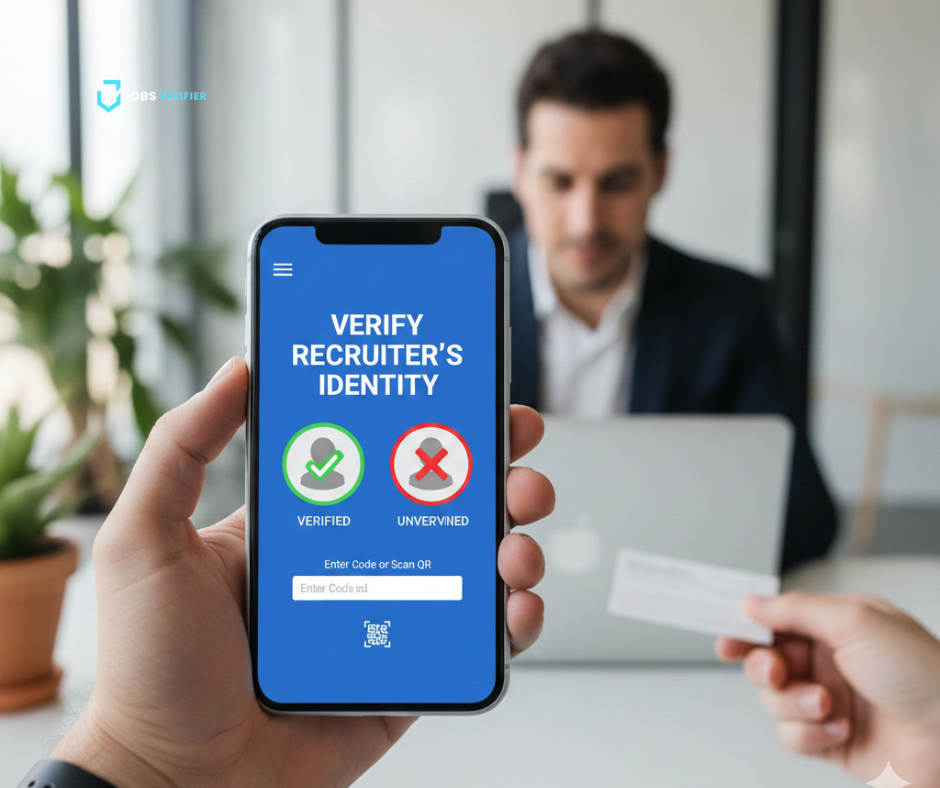
✅ 5. Verify the Recruiter’s Identity
Never trust a job post without checking who’s behind it.
Search for:
- Recruiter’s name on LinkedIn
- Their job history
- The company they work for
- Their profile photo consistency
🚩 Red flag:
If the recruiter doesn’t exist online, or their profile has:
- No history
- No connections
- No real picture
- Recently created account
…it’s likely a fake profile.
✅ 6. Look for a Salary Range (If Provided)
While not all employers show salaries, a professional company often gives at least an estimate.
Healthy salary signals:
- The range matches market value
- Benefits are clearly explained
- No exaggerated income promises
🚩 Red flag:
“Earn $150,000 from home — no skills needed!”
Scam alert.
✅ 7. Check the Interview Process
Companies usually mention their interview format.
Genuine interview processes include:
- HR screening call
- Technical test
- Department interview
- Final HR review
🚩 Red flag:
- Interviews conducted only through WhatsApp Chat
- No video calls
- No HR involvement
- No official email invites
These unusual processes indicate fake recruiters.
✅ 8. Look for the “Verified” Badge on JobsVerifier
This is one of the strongest trust signals.
A Verified Company listing has passed checks on:
✔ Website identity
✔ Social media presence
✔ Hiring behaviour
✔ HR authentication
✔ Scam risk rating
When you see the Verified Badge, it means the employer is authentic, trusted, and safe to apply to.
✅ 9. Read Company Reviews and Feedback
Use JobsVerifier’s AI-powered reviews to understand the employer’s:
- Culture
- Employee satisfaction
- Management quality
- Hiring patterns
- Red or green flags
AI reviews help you avoid toxic workplaces before stepping into them.
✅ 10. Check for Advanced Scam Signals
JobsVerifier warns candidates about:
- Jobs asking for upfront payments
- Training fees
- “Security deposits”
- Requests for personal IDs early
- Commission-only jobs disguised as full-time roles
These are all common scam tactics.
🚩 Never pay to apply — ever.
🎯 Quick JobsVerifier Checklist (Copy & Save!)
Before applying, ask yourself:
✔ Is the company real and easy to research?
✔ Are the website and social media authentic?
✔ Is the recruiter legitimate?
✔ Is the job description detailed and realistic?
✔ Is the email domain professional?
✔ Does the employer have genuine activity online?
✔ Are there any scam indicators?
✔ Does the job have a Verified Badge?
✔ Do AI reviews show positive signals?
✔ Does anything feel suspicious or “too good to be true”?
If everything looks clean — go ahead and apply with confidence!
🌟 Why This Checklist Matters
The job market is evolving fast. Scams are getting smarter, fake employers are increasing, and many job seekers fall into traps because everything “looks real.”
This checklist helps candidates:
- Protect their personal information
- Avoid scam recruiters
- Apply selectively
- Save time
- Choose better and safer opportunities
- Build a confident job search strategy
With JobsVerifier, candidates don’t just search for jobs —
they search smart, safe, and informed.
🎉 Final Thoughts
The future of job hunting belongs to candidates who verify before applying. Using this JobsVerifier Checklist, you can avoid fake postings, stay ahead of scammers, and make more confident career decisions.
Every application is a step toward your future — and JobsVerifier makes sure each step is safe, authentic, and trustworthy.